Monday, April 18, 2022

Seeding depth affects corn plant emergence uniformity and grain yield

Planting depth effect on mesocotyl length. (Click to enlarge)

Rarely do we see a paper published on corn seeding depth and the subsequent impact on grain yield. Precision technologies have allowed for capabilities of variable rate seeding, multi-hybrid planting on the go, and the ability to vary planting depth in real time in response to real-time soil moisture data. In a paper published by Nemergut et al. (2021), corn seed was planted at 1-, 2-, and 3-inch depths on two soil types in Ohio over three growing season (2017 to 2019). Shallow planting resulted in less uniform more extended emergence periods than 2- and 3-inch planting depths. If a plant emerged within 3 days of the first emerged neighboring plants, then there was no effect on plant grain yield. Any plant that emerged more than 3 days after the first emerged plant had a 5% decrease in kernel weight per day. Grain yield per plant increased as planting depth increased. Grain yield per acre was significantly increased by planting depth with seed planted at 2- and 3-inches yielding 8 or 10% more than the 1-inch seeding depth on one of the two soils. Other researchers have also shown improving emergence uniformity can positively increase yield, and that optimum planting depth may vary by field.

Further Reading

Nemergut KT, Thomison PR, Carter PR, Lindsey AJ. Planting depth affects corn emergence, growth and development, and yield. Agronomy Journal. 2021;113:3351–3360.  https://doi.org/10.1002/agj2.2070

Please forward this article to those who may find the information useful.
Click to subscribe or unsubscribe.

Thursday, April 7, 2022

What if the 2022 Growing Season is a Drought?


U.S. Drought Monitor map released April 7, 2022. (Click to enlarge)

There is a lot of concern among farmers about dry spring conditions as we head into the 2022 growing season. Significant areas of the western U.S. are encountering extreme to exceptional drought. In the Midwest, the southern tiers of Wisconsin counties and the northern 1-2 tiers of Illinois counties are abnormally dry or under moderate drought.

Figure 1 describes the 30 yr monthly average precipitation at the UW Agricultural Research Station in Arlington. Only 23.5 inches of precipitation was measured during 2021 compared to the 30-yr annual average of 35.2 inches. We typically get most of our precipitation during April, May and June. The variability (risk) of precipitation patterns during April to June is quite high ranging from 3.8 to 5.4 inches (standard deviation= + 1.9 to 2.7 inches). Monthly precipitation amounts can range from 1.8 to 7.9 inches of precipitation during April, May and June.
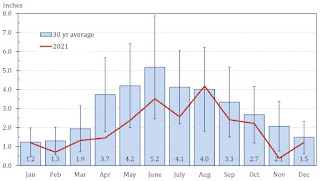
Figure 1. Monthly precipitation at the UW-ARS in Arlington. Data were derived from the Midwest Regional Climatological Center. Error bars are the standard deviation of the 30 yr monthly average. (Click to enlarge)

During 2021, monthly precipitation was outside of the error bars in Figure 1 only during April and November. Drier conditions during April allowed for early planting, while drier grain moisture was observed at harvest. The month that was average for precipitation was August which is the grain-filling period for corn. No 2021 precipitation monthly average was above the 30 yr monthly average. So even though precipitation was one of the lowest on record, the distribution was adequate for near-record grain yields.

Some of the current drought conditions described by the U.S. Drought Monitor for Wisconsin and Illinois are a holdover from the 2021 season. Since January 2022, the amount of precipitation measured at Arlington is average. Soil profile water content is likely lower than normal. 

How Do We Prepare for the 2022 Growing Season?

The short answer is that you "manage for the average." Don't change things too much unless you have been considering and preparing changes in your management style for some time. The weather during 2022 could be cooler/warmer and/or drier/wetter than normal.

Again, I would "manage for the average" during 2022. No one can predict the weather. If you are convinced that the weather is going to be drier than normal, then I would consider the following:

  1. Select a hybrid that is bio-engineered to include drought "tolerant" transgenes. Be wary of hybrids traditionally bred for drought "resistant" traits.
  2. Use hybrids with the Bt-ECB bio-engineered trait. Stalk integrity will be important for water molecule movement within the plant and will likely increase standability at harvest. Mycotoxin issues are more often observed in drought stressed years because of increased corn borer activity.
  3. Select a hybrid that is shorter-season than typical for your field. You will give up yield compared to a full-season hybrid, but the the shorter-season hybrid will go through pollination earlier when soil profile water might be adequate to ensure pollination.
  4. Plant early. Planting corn early has the same effect as selecting a shorter-season hybrid. Plants will go through the pollination phase earlier when soil profile water content is greater.
  5. Lower plant population. Our data shows that grain yield is not affected by plant population during a drought year. By lowering your plant population you capture some return on investment by lowering seed cost.
  6. Rotate your crops. Rotated corn grain yield during a drought year is increased (25 to 30%) more than continuous corn. 
  7. Use no-tillage. Residue on the soil surface acts as a mulch and a boundary layer for evaporation from the soil surface.
  8. Control weeds. Weeds will compete with corn for water resources.
  9. Do not over-apply nitrogen. Apply at MRTN rates. Nitrogen increases corn leaf area thereby increasing the potential amount of surface area and cooling load that the plant requires for transpiration.

Some of these management decision changes have the potential to leave yield in the field during a normal weather year. As we saw during 2021, some of these decisions are about timing of precipitation events. I remember the 2005 and 2012 when weather conditions were dry through mid-July. Adequate rains came in mid-July and soils that had higher soil water content allowed plants to escape drought effects on pollination. For some, early planting date and shorter-season hybrids did not work and fields were abandoned.

Please forward this article to those who may find the information useful.
Click to subscribe or unsubscribe.

Thursday, March 17, 2022

The 2021 UW Agronomy Report on Corn Management Systems and Cultural Practices

Photo by Sevie Kenyon

Agronomy is the science of sustainable land management. Agronomists generate, integrate and apply science-based knowledge and principles to crops grown for food, feed, fiber, and fuel that are efficient, environmentally sound, and sustainable for future generations.

The mission of the University of Wisconsin Corn Agronomy program is to answer corn management questions expressed by Wisconsin farmers and industry. Although farmers are the primary clientele, the general public ultimately benefits and pays for this program. Therefore, we consciously evaluate impacts of this program on society and keep the public aware of how we spend their money.

Specific objectives of this program focus on management decision-making regarding crop productivity, quality, and production efficiency including hybrid selection, rotation, tillage systems, and replant and yield loss damage assessments. Emphasis is on impacts of cropping practices on grower profitability, the environment, and natural resource conservation.

Every year, approximately 12,000 plots are planted, maintained and harvested at 14 locations throughout Wisconsin. Research conducted by the University of Wisconsin Corn Agronomy program is published for each production season at http://corn.agronomy.wisc.edu/Research/. The report for 2021 can be downloaded at http://corn.agronomy.wisc.edu/Research/Report/2021.pdf

A summary of the weather for the 2021 production season can be found for Arlington at http://corn.agronomy.wisc.edu/Research/Weather/ARL/2021.pdf and for Marshfield at http://corn.agronomy.wisc.edu/Research/Weather/MAR/2021.pdf

Results for the 2021 projects include:

  1. 2021 WISCONSIN CORN HYBRID PERFORMANCE TRIALS Grain - Silage - Specialty - Organic
  2. Corn Hybrid Growth and Development
  3. Syngenta Private Silage Trials
  4. Plant Density and Hybrid Influence on Corn Grain and Silage Performance
  5. Date of Planting and Hybrid Influence on Corn Forage and Corn Grain Yield
  6. Plant Density and Row Spacing Effects on Corn Grain and Silage Yield
  7. Alfalfa - Corn Response to Rotation
  8. Corn - Soybean Response to Tillage and Rotation
  9. Corn - Soybean - Wheat Response to Rotation
  10. Crop Rotation Response to N-rate
  11. Sweet Corn Response to Leaf Area Reduction
  12. Tillage Systems in Corn and Soybean Production Systems
  13. Multi-factor Management Decisions for Continuous and Rotated Corn

We appreciate the financial support, product support and cooperation from the agri-business and grower groups without which this work would not be possible. We have done our best to see that the experiment design and data collection to date is complete, timely and free from errors. However, if you detect an error in these results, please call it to our attention.

We look forward to new research opportunities during 2022, as well as, completion of some studies underway. Please feel free to suggest ways that we can cooperate in the 2022 growing season.