Wednesday, May 2, 2012

Weather Updates for the 2012 Growing Season

So just how does this year's weather compare to other years. Right from the start, the 2012 growing season is unique, especially with March weather. Growing degree unit (GDU) accumulation for March was greater than GDU accumulation for April at both the Arlington and Marshfield University of Wisconsin Agricultural Research Stations. To track the weather see the charts at the top of the "Season" page on the Corn Agronomy website. Periodically I will update these charts as the season progresses. The charts show precipitation (daily and accumulated), maximum/minimum air temperatures, GDU accumulation for various planting dates, and daily and accumulated GDUs. These data are collected from the Automated Weather Observation Network maintained by Dr. Bill Bland (UW Soils) and from National Weather Service observers at the stations.

Sample weather report for the Arlington and Marshfield University of Wisconsin - Agriculture Research Stations.
In this report I also include the weather patterns for the coolest/warmest and driest/wettest years of these stations from April 1 to the date posted. These years are selected by using + one standard deviation from the 30-year normal (1982 to 2011). For these selected years that deviate, I then track the weather that occurs later during their growing seasons.


Monday, April 2, 2012

Patience When Thinking about Planting Corn this Year

The weather this year has many farmers and agronomists wondering, "What if?" What if I had planted in March? What if I plant before crop insurance kicks in on April 11? What if I wait until "normal" planting dates?

Every year we recommend, when planting prior to April 20, that field conditions must dictate when we start planting. This year field conditions were right in March. The historical optimum planting date for corn is May 1 in southern Wisconsin and May 7 in northern. Every field and farm likely has slightly different optimum planting dates. We also know that delayed planting often results in lower yields as well as the "double-whammy" of higher grain moisture, which can be as expensive as lower yields.

Since 1991, we have conducted a planting date trial every year at the UW Agricultural Research Center in Arlington. We target May 1 as the optimum planting date and we plant as early as field conditions allow before that date and every two weeks after (May 15, June 1, and June 15). Often when we plant corn on the first date, there is still snow on the sides of the fields in ditches.

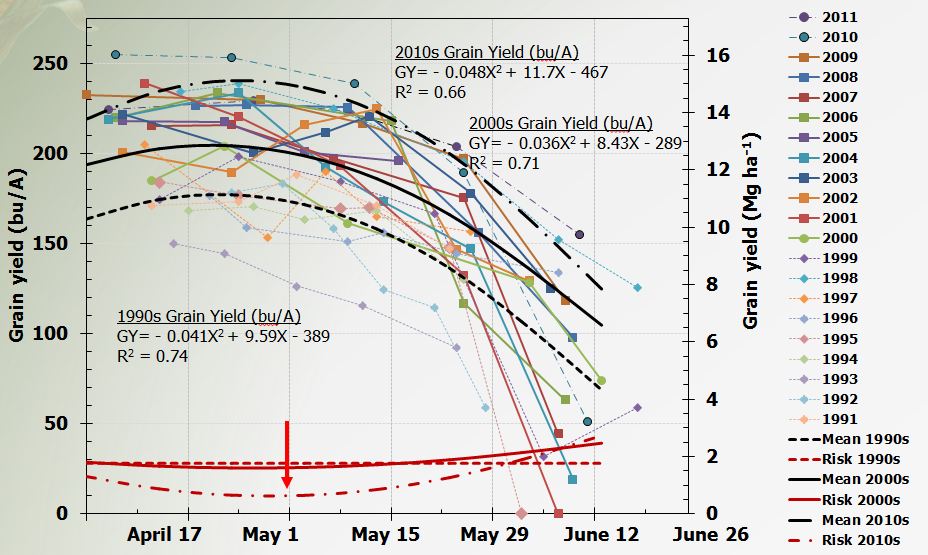
Figure 1 shows the grain yield response to planting date and the risk associated with each planting date of a full-season hybrid at Arlington. The heavy lines are the averages that have occurred during the 1990s, 2000s and 2010s (so far). Both 2010 and 2011 were exceptionally high yielding years. In each decade we have seen an increase in grain yield. The planting date response pattern is similar between decades. The optimum planting date has been around May 1. All April planting dates were greater than 95% of the optimum date. It isn't until mid-May that yields fall below 95% of the optimum planting date. During 1995 and 2001 no grain yield was produced on the last planting dates in June.


Figure 1. The corn grain yield response of planting date at Arlington, WI. Grain yield risk is the standard deviation (+ bu/A) associated with each planting date. The arrow is the historical optimum planting date.

During the 1990s, planting date risk (or the standard deviation) was the same (+ 28 bu/A) regardless of planting date. During the 2000s, risk was curvilinear with higher risk during later planting dates. So far in the 2010s, planting date risk is also curvilinear with the least risk occurring on the historical optimum planting date of May 1.

The earliest we have ever planted corn at Arlington was during 2010 in a trial designed to test the effect of seed treatments on early season stress (see report here). In that trial we planted March 31, April 14, and May 18. This was not a planting date trial since treatments were planted in side-by-side blocks by planting date, but it gives us some sense of what might happen with March planting. The average yield for each respective planting date among all of the treatments was 227, 238 and 227 bu/A. 

Insurance coverage needs to be considered when thinking about when to start planting corn. For the latest on crop insurance see Mitchell (2012).

When planting early we are most concerned about the last spring killing frost. This has to occur before the growing point moves above ground after the V5 developmental growth stage (Abendroth et al., 2011). We don't have to go too far back to remember the devastating effects of a late-killing frost that occurred on June 20, 1992 when most of the Wisconsin crop was between V6 and V8. Unfortunately, the last killing frost is difficult to predict and manage for.

Of course replanting can occur for numerous reasons besides late-killing frost. The biggest concern in a replant situation is hybrid choice of the replanted hybrid. Can I replace the hybrid I chose? If I have to settle for another hybrid, what is the yield penalty of the alternative hybrid? What is the yield penalty of the later planting date? What about the "double whammy" of lower yield AND higher grain moisture?

Patience is key here. You only get one chance to do things right in a field. Be ready to go. Get as much of your spring work done as you can. Waiting until the crop insurance dates kick in is not unreasonable.

Literature Cited

Abendroth, L.J., R.W. Elmore, M.J. Boyer, and S.K. Marlay. 2011. Corn growth and development. PMR1009. Iowa State University.

Mitchell, P. 2012. Crop Insurance Implications of Planting Crops Early. Wisconsin Crop Manager, March 21, 2012 http://ipcm.wisc.edu/blog/2012/03/960/

For the web posting of this article see http://corn.agronomy.wisc.edu/AA/A093.aspx.


Tuesday, December 27, 2011

Wisconsin Corn and Soybean Conferences


Profitable corn and soybean production is extremely important to Wisconsin agriculture. In 2009, Wisconsin producers planted nearly 3 million acres of corn worth $1.0 billion. Another 1 million acres worth $0.7 billion was planted for corn silage to support our dairy industry. Soybeans worth $0.6 billion were harvested from 1.6 million acres.

Faced with fluctuating prices and rising production costs, farmers today must be well informed about new technologies to be profitable. The 2012 Corn and Soybean Conference meeting series is sponsored by the Wisconsin Corn Growers Association, the Wisconsin Soybean Association and UWEX.
These Corn and Soybean Conferences are designed to provide technical insight, practical advice and interaction with university and industry experts and fellow growers.

Those attending will learn about:
The "new" economics of production
Selling strategies for corn in the new market
Top 10 Yield Detractors in Soybean
Producer tips for successful corn production
Will we ever see $7/$15 corn/soybean again?
Cash versus futures pricing
Storage decisions
Evaluating market outlook and alternatives
Traffic management to reduce compaction
Producing 300 bushel corn - Lessons learned
Fungicides: Are they working yet?
The latest on Twin-row corn production
An update on trucking issues in Wisconsin

We encourage you to pre-register early since space is limited. Invite a neighbor to join you. Contact the County Extension Office that will be hosting the meeting you plan to attend.

The meeting dates and locations for the 2012 Wisconsin Corn and Soybean Conferences are:

Tuesday, January 17 – Seymour  – Doxbee’s Banquet Hall
Wednesday, January 18 – Menomonie – Stout Ale House
Thursday, January 19 – Darlington – Bridges Banquet Center


2012 Wisconsin Corn Conference Program

9:30 am
Registration
Coffee, milk, rolls in Exhibit Area

10:00 am
Welcome
Opening remarks by Host Agent

10:10 am
2012 Corn Production and Management Keys to High Yields and Profitability
Dr. Joe Lauer - UWEX Corn Agronomist

11:00 am
What’s Ahead For Wisconsin Corn and Soybean Growers - How Our Associations Helps Producers
Mr. Bob Oleson - WCGA/WCPB Executive Director and WCGA/WCPB Directors
Mr. Bob Karls – WSA/WSMB Executive Director and WSA/WSMB Directors

11:30 am
What's New in Seeds and Ag Products for 2012
Industry Co-sponsor Representatives

12:00 pm   LUNCH
Exhibits open

1:00 pm
Top Ten Soybean Yield Limiting Factors
Dr. Shawn Conley – UWEX Agronomist

1:50 pm
Back-to-Back High Yields and Prices: Now Where?
Mr. David Moll - UWEX Ag Economist

2:40 pm
Tips for Successful Corn Production and Profitability

Seymour: Is less more? Are twins better than singles? – Kevin Jarek, Outagamie County Agent

Menomonie: Timing fungicide applications – Is there a benefit? – Katie Sternweis and Jerry Clark, Dunn and Chippewa County Agents

Darlington: Wisconsin Agricultural Transportation Regulations – Ted Bay, Grant County Agent and TBD, Wisconsin State Patrol-Motor Carrier Enforcement Section

3:30 pm
Conference Adjourns

Support for the 2012 Wisconsin Corn and Soybean Conferences provided by:
Dairyland Seed Company
First Capital Ag
Legacy Seeds
AgriGold
Legacy Seeds
Partners in Production
Mycogen Seed
Pioneer Hi-Bred
Syngenta
Monsanto
Contree Sprayer and Equipment Company
Wisconsin Corn Promotion Board
Wisconsin Soybean Marketing Board


Please join us at a meeting in your area.  To download the brochure and registration form, click here.